January 11th, 2010

The type event in 2010 started with the letter engraving demonstration at the Ota Bunka no Mori, in Ota Ward, Tokyo. An engraver craftsman Kinnosuke Shimizu, who turned 88 years old on that day, is one of the last letter original engraver craftsman in Japan.

Left: Ota Bunka no Mori center in Ota Ward where the demonstration event was held. Right: Attendees were gathering around Shimizu’s table.

When I entered the room, he already started cutting letters sitting on the floor in front of a wooden work table. A bunch of attendees were gathering and crowded around his table. A desk lamp illuminated his fingers, but it is hard to see how he cut the letter because the metal stick he was going on was very small. Sometime, the stick he picked was shining in his fingers. Using an old loupe, Shimizu gazed at the stick. He sometime rotated it, and the tiny chisel was slightly moving on the top of the stick. He showed superb technique and made letters slowly one by one. He seemed to be very fine. It was hard to believe he turned 88 years old today.

Left: Shimizu was sitting on the floor toward his work table. Right: Shimizu explained how to curve letters to attendees.

While he concentrated cutting letters, often said that “Let me know if you have a question, I can answer them working on demonstration.” So I hesitantly asked him some questions.

According to him, he started cutting letters when he was 14. He worked hard all the day, it took about five years to cut letters well. The workshop he joined had five craftsmen, included him but it had few dozens craftsmen at peak, which produced about fifty letters per day.

I expected cutting tiny letters such a ruby, so called Rubi in Japanese and is used for a furigana superscripts, takes a longer time than larger ones such Shogo 初号. But he told me that “Cutting smaller letters are easy. Rather, large size letters need to take a time. They require accurate quality, so, it took much care for cutting them. While cutting average small letters takes about a twenty minutes, but average large size letters such Shogo take a few hours. Of course it depends on its size and complexity.”

Left top: He gazed at the stick through the loupe. Right top: A tiny stick he picked was shining in his fingers. “Cutting reversed letters is easier than writing normal letters. I can’t write normal letters well,” he said with a smile.

“Do you have any pupil or is there any followers to try to make it?” I asked. Then “No, there’s no demand for engraving letters at all, but I can teach you if you want,” he answered with a smile. “Because of appearing new technology, (might be the Benton cutting machine and a photo type setting technology) most of punch cutters had to retire, then he left the job about fifty years ago. After some decades passed, however, some type designer asked me to demonstrate cutting letters at the letter press event. At first, I denied because I forgot, plus I no longer had tools for that. But my wife still had all of them. So, I tried to do that, then I could,” he explained.

“I would like to say thank all of you guys. Thanks to everyone’s help, I have been a craftsman for a long tome and am able to show this demonstration today. It was a pity when I lost a job because of new technology, but I’m happy I can show you guys cutting letters due to all of your interests,” he added.


Left top: A T-formed loupe stand he customized. Right top: Hold a letter stick like this. Left bottom: Left hand which holds a letter stick is set on the end of the horizontal bar, and right hand which grabs a chisel is put on the right side. Right bottom: An enlarged letter stick reads 鶴龜 pronounce Tsuru Kame, means crane and turtle, which are the symbol to bring happiness. 鶴 has 21 strokes, and 龜 has 16 strokes within about 5mm square each.

Left: A grind stone, Right: All chisels he uses are made by himself. He customized them to fit his hand and fingers. Meanwhile, counterpunches are used in making Latin alphabet punches, Shimizu grave letters without any counterpunch. Almost of Kanji letters have many complicated crossing strokes, which create thousand kinds of counter shapes. That’s why, making counter punches to fit all kind of counter shapes is not economic way at all.

When we are talking about a font regardless of digital or letterpress, we tend to focus on type design or typography, which is to say what we can see only. However, the fonts we have now and letterpress on an old book were provided by the collaboration between designers and engineers or craftsman like Shimizu. Without craftsman/engineer’s skills and big efforts to making fonts, these are never provided to users. When we get a font, I think we have to imagine not only designers but also craftsmen and engineers who had worked hard to make it.


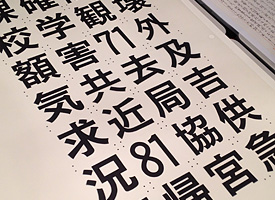
Left top: Shogo 初号, engraved directly by Shimizu. Right top:Original letters made by Shimizu were displayed at the corner in the room. Visitors were able to see the superb skills Shimizu had. Letters were shining and glaring and had sharp edge. Left bottom: He prepared these letters for this event. Right bottom: Rubi letters. Katakana letter within 2mm square.

As I mentioned above, it was the Shimizu’s 88th birthday. After the demonstration event, the birthday party celebrates his Beiju “米寿, 米 consists Kanji numeral 八十八, reads eighty-eight, and 寿 means celebration” was held nearby the event place. That’s too bad, I couldn’t join the party, but I was sure the party must be exciting. I hope to see his demonstrations again. Congratulations, Mr. Kinnosuke Shimizu.

Gratitude:
To know some terms for letterpress and electrotype, I asked typophilers about them here. I would like to say thank to those who helped me out.

January 5th, 2010

2010 has come. In Japan, we generally exchange a New year’s card with friends, colleagues and relatives instead of a Christmas card. Here is my card. When we design a new year card, we use an image of animal to express new year, which is called Eto 干支. From mouse to wild boar, twelve kinds of animals are the members of Eto, which is also known for the Japanese ancient counting way not only years but also the day and time by using these twelve animals, which revolve every year one by one like Duodecimal. Tiger “寅:tora” is the symbol for 2010.

Left: My new year card in 2010. Right: I bought a white arrow when I went to first visit to Tomioka Hachiman Shrine. And a lovely tiger ceramic bell my brother gave me.

The later part of last year, I couldn’t provide any articles to update my blog. I don’t want to excuse it was because of the hard schedule. But as I concentrated on the type design project I joined, so some type design works were available by the end of last year.

Thanks to the people who interested in this blog, I could get some comments and email last year, which encouraged me a lot, and I found those who are interested in Japanese font and type design all over the worltd. I was glad to hear from all of them. I’m sure I’ll post topics related to Japanese type design and typography in 2010. I wish we meet again and hope to get your interests to this site. Thanks.

October 21st, 2009

A bunch of designers were coming to Automotive Designer’s Night Tokyo which was held at AXIS gallery, in Roppongi, Tokyo, titled Kurumaza 車座, literary means sitting in a circle, 車 means car in Japanese, as a pre-event of Tokyo Motor Show 2009. The room was packed and loud, so it was hard to catch what neighbors are saying. Attendees might discuss and talked about something hot topic related to car vehicles or ecology issues. The medias reported the Tokyo Motor Show was shrinking because of the withdrawal of Euro and US car makers, but the room was warming up and seemed to be no sign of descending car market but filled with emotions to the future.

The sponsor companies showed its products there, Denso previewed Good Design Award 2009 Frontier Design Award Winner Driver’s font and provided the series of business card-sized papers to applicants. They could get the cards with their name printed by Driver’s font. It contained 4 cards, 3 styles of Driver’s font, Driving, Neutral and Sports Mode, plus a serial number card. There seem to be a lot of hurdles in order that Driver’s font will be available in automotive instruments, but I hope the fonts will be welcomed by car makers.

The series of cards provided by Denso at Automotive Designer’s Night Tokyo.

Tokyo Motor Show 2009 will be held from October 23rd through November 4th.

October 1st, 2009

Japan Industrial Design Promotion Organization announced the results of the Good Design Award 2009 on October 1st. Good Design Award is the only annual comprehensive design commending system in Japan, and the award-winning works get the right to show the G-mark for its promotion on the several kind of media by paying annual fee. The award winning works in 2009 contained three font related works.

Driver’s font
Driver’s font designed by Type Project collaborated with Denso, is the supplier mainly car equipments and air conditioner, got the Frontier Design Award.

Driver’s font was designed to support car drivers in 2007 as a prototype work, which is now in progress to develop, based on the assumption in light of the research for driver’s situation.

While driving a car, a driver needs to concentrate gazing forward and have to glance at information on the equipment panels such a speed mater or car navigation system. The driver recognizes the information by remembering the image what the panels showed after glancing at the panels. The driver repeats these actions concentrating forward. The interval to check panels will change alongside its car speed. To keep the impressions that driver imprinted, the letters needs to generate clear legibility and strong images. Driver’s font gives driver the stabilized visual images by modulating letters along with car speed. When the car in high speed, the letters become a bit bolder to push strong images to the driver than the car is staying.

Driver’s font has three styles, Urban mode and Enthusiast mode, plus Enthusiast Italic “Power Band”mode for Sports mode. The letters in Enthusiast mode enhanced the characteristics of the letters such as the terminals and thickness of the strokes and serifs, compared with the Urban mode, which helps drivers be able to easily catch the letters on the panels in high speed.

Reference: AXIS magazine vol. 136 contains an article on Driver’s font.

Iwata Universal Design font
Iwata Universal Design font got the Life-Scape Design Award. This font is the pioneer of the Universal Design font trend in Japan. Universal Design font, abbreviated UD Font, is becoming popular in Japanese typeface market after Iwata’s UD font was released in 2006. Above all, Product design field welcomed to use UD fonts designing products with Universal Design philosophy. Iwata collaborated with Panasonic, is the major home-electronics, audio and visual device maker, to make its UD fonts in order to help those with weak-eyes and aged-eyes. The other type foundries followed to make UD fonts.

Fontpark 2.0
MORISAWA Fontpark 2.0 designed by Yugo Nakamura (tha ltd, yugop.com) in 2008 is a unique attraction interface. User can play to draw a picture using strokes and elements of letters from Morisawa Font Library. And it is available to save the picture to the web site, then visitors can watch the archives replaying making process of the work. Enjoy this font park.

September 26th, 2009

At nine o’clock sharp, the JR Shinjuku station the Chuo line track 10, I got on the Limited Express Azusa #9 bound for Kofu, Yamanashi Prefecture neighboring Tokyo, to join the event cerebrated the centennial anniversary of Tomi-no-oka vineyard by Suntory, beverage and liquor maker. As I designed a logotype for the vineyard’s centennial anniversary, I’ve been thinking to visit there during the centennial events would be held by the end of this year. The event I submitted included a tour in the winery and a special dinner with five Tomi-no-oka wines.

As the train approached Kofu, vineyards spread along with the track, Yamamashi is known for producing some kinds of fruits, especially Kofu, where is the land suitable for vineyard.

After arriving at the Kofu station, to waste a time until the tour would start, I came by Yamamashi Museum to see the Millet collection. Taking a lunch with Houtou noodles, famous as popular food for Yamanashi people, then returned to the Kofu station.

Getting on the shuttle bus to the vineyard, it took around twenty minutes, then the buildings in the winery covered with white wall appeared among the mountain. After an entrance procedure, the tour started with the guidance by Mr. Shounai, Brewery Manager.

As the tour started from the evening, all production line in the factory had already finished, we just went through the brewery facilities to see all rooms one by one and arrived at the wine cellar in the tunnel of the Tomi-no-oka hill. A hundreds of wine casks were laid quietly and waiting for bottling. The next room preserved the thousands of wine bottles waiting for the release date.


After watching the facilities, we got on the bus again and went to see the vineyard. The bus went through the forest, then the vineyards appeared in front of the bus. The vineyard spread on the southern slope on the hill with direct sunlight. From the top of the Tomi-no-oka hill, I could see the Kofu Bonchi Basin surrounded by high mountains called Minami Alps mountain chains, named after the Alps in Switzerland, but unfortunately, clouds covered Mt. Fuji.

Shounai allowed the tour members to bite grapes in the vineyard, known as Merlot for red wine, where would be harvested soon. “Wow! Delicious and Sweeeet!!” I didn’t expect the grape for wine is very delicious.


Then, evening twilight has come, the sky turns dark, the town lights in Kofu area started to lit up. The twilight dinner started and served beautiful and brilliant skilled dishes by the ingredients in Kofu with five Tomi-no-oka wines. We enjoyed the marriage with delicacies and wines. I was very glad to find the vineyard is excellent and fantastic place, and it was a great chance to work for the vineyard. To the next hundred years of Tomi-no-oka vineyard, Cheers!

Left: The bottle cerebrated the centennial anniversary for the Tomi-no-oka labeled with the logotype I made (Not for sale). Creative director of Suntory send me them after the tour. Right: The quarterly magazine published by Suntory titled “クォータリー: Quarterly” Vol.88 described the history of Tomi-no-oka vineyard.